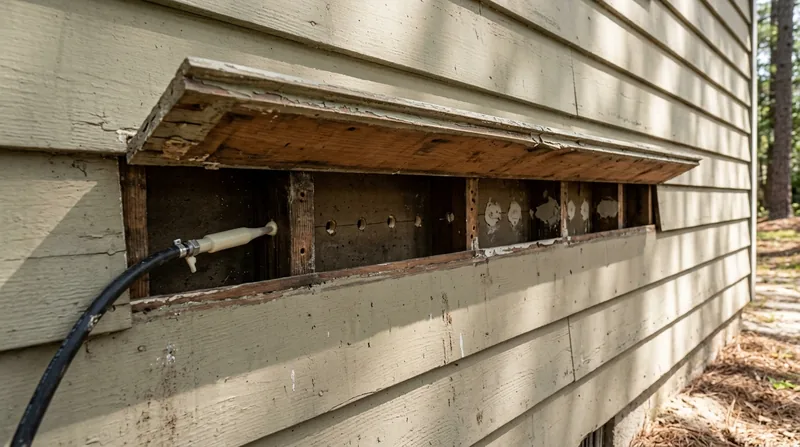




Wall & Injection Foam Insulation in Fayetteville fills empty wall cavities from the outside without demolition, turning 1950s brick ranches, Massey Hill mill houses, and Haymount bungalows into tight, conditioned spaces. The North Carolina Sandhills climate runs humid summers at 130-150 degrees in vented attics and mild winters, and those empty cavities in pre-1980 frame and brick-veneer walls bleed conditioned air and let moisture move freely. Injection foam seals the cavity completely, controls moisture migration, and holds the R-value steady year-round. It's the retrofit answer when you can't tear out walls, and it's the difference between a house that sweats through August and one that doesn't. We've been doing this work since 2012 across Fayetteville, Hope Mills, Spring Lake, Raeford, Lumberton, Southern Pines, Pinehurst, and the surrounding communities. Call us at (472) 263-8386 for a free estimate, or read on to understand how injection foam works and what it costs in your neighborhood.
Why Empty Walls Matter in Fayetteville Homes
Most homes built before 1980 in Fayetteville and the surrounding areas were framed with empty cavities, no insulation at all. Brick veneer over wood frame, lap siding over studs, block foundation walls, all of them sit hollow. In a humid subtropical climate where summer indoor air is 75 degrees and outdoor air is 90 degrees at 75 percent humidity, that empty cavity becomes a condensation highway. Moisture moves inward through the exterior, condenses on the inside face of the sheathing or the back of the brick, and the cavity stays damp. Drywall on the interior sees no air movement to dry it out, and the wood frame begins to absorb moisture year after year. Injection foam fills that cavity completely, stops the moisture gradient, and controls both temperature and humidity at the same time.
- Empty cavities in pre-1980 Fayetteville homes allow humid outdoor air to migrate inward and condense on cool interior surfaces.
- Moisture-laden cavities support mold growth on wood framing and drywall, especially in the humid Sandhills climate.
- Injection foam seals the cavity completely, blocking air and moisture movement while maintaining R-value consistency.
- Filled cavities reduce the temperature swing inside the wall, keeping interior surface temperatures closer to room air.
- No demolition means lower labor cost and no disruption to occupied homes, rentals, or multi-unit buildings.
This is why injection foam retrofit is the standard answer for Massey Hill mill houses, Haymount bungalows, and the 1950s-70s brick ranches that fill Bonnie Doone and Vanstory Hills.
Key info: A Massey Hill mill house built in 1955 with lap siding over empty studs and a brick ranch in Bonnie Doone with hollow brick veneer both benefit equally from injection foam. The retrofit takes one day, leaves no interior mess, and the cavity stays sealed for the life of the house. No re-settling, no moisture re-entry, no maintenance.
For more on how moisture affects insulation performance, see our crawl space spray foam insulation page, where the same humidity principles drive the retrofit decision.
How Injection Foam Installation Works in Fayetteville Homes
Injection foam retrofit is a measured, non-invasive process. We drill small ports (typically 1 to 1.5 inches in diameter) through the siding course or along a mortar joint, then inject closed-cell polyurethane foam into the cavity under pressure. The foam expands to fill the space completely, and once cured (typically 24 to 48 hours), we patch the ports. The exterior looks untouched. Interior drywall stays in place. No framing is exposed, no mess inside the home, and the cavity is sealed from top to bottom in a single pass.
- We locate all studs, fire blocks, and cross-bracing using a stud finder to plan port placement and avoid hitting utilities.
- Small access ports are drilled under a siding course or along a mortar joint where the patch will be invisible.
- Closed-cell foam is injected at the manufacturer's recommended pressure and temperature, filling the cavity completely.
- Foam expands and cures in place, adhering to the framing and creating an air and moisture seal.
- Ports are patched with caulk or siding repair, and the exterior finish is restored to match the original.
- Re-entry is permitted after 24 to 48 hours, depending on temperature and humidity.
The result is a sealed, insulated cavity that performs consistently through Fayetteville's hot humid summers and mild winters.
Real example: A 1,200-square-foot brick ranch in Spring Lake with 2x4 cavity walls (R-13 equivalent if blown with fiberglass, R-20+ with closed-cell injection foam) can be retrofitted in 5 to 8 hours. Ports go in at 16-inch centers, and the cavity is sealed. No interior disturbance, no temporary relocation needed. Total wall area is typically 1,800 to 2,200 square feet, and injection covers all of it in a single job.
See our closed-cell spray foam page for technical details on R-value, moisture control, and why closed-cell is the standard for retrofit wall cavities.
Injection Foam Methods and Coverage
| Approach | Description | Best for |
|---|---|---|
| Closed-Cell Injection Retrofit | Small drilled ports, pressurized closed-cell foam fill, cured in place, ports patched. Achieves R-20+ in 2x4 cavities, R-24+ in 2x6. | Pre-1980 homes with empty brick veneer, frame, or block walls. Massey Hill mill houses, Haymount bungalows, 1950s-70s ranches. Moisture control is critical. |
| Staged Cavity Fill (Multi-Pass) | Ports at multiple heights allow staged foam injection, ensuring complete fill in tall cavities or those with cross-bracing. Each pass cures before the next. | Two-story homes, cavities over 12 feet, walls with complex framing or fire blocks that require multiple injection points. |
| Selective Wall Retrofit | Target specific walls (north-facing, exterior-facing living areas, or cold zones) rather than the entire home. Reduces scope and cost while addressing priority areas. | Budget-conscious retrofits, rental properties, or homes where only certain rooms feel drafty or cold. Prioritize exterior-facing walls in living zones. |
| Full-Envelope Injection | All exterior walls, perimeter of interior partition walls facing conditioned space, and band joists are sealed and filled. Comprehensive air sealing and insulation in a single project. | Homes with persistent drafts, high utility bills, or planned long-term occupancy. Combines injection foam walls with rim joist sealing for complete envelope control. |
Wall & Injection Foam Insulation Cost in Fayetteville: What to Expect
Injection foam retrofit pricing in Fayetteville runs from $2 to $4 per square foot of wall area, depending on cavity depth, wall height, access (brick veneer versus lap siding), and the number of ports required. A typical 1,200-square-foot home with 1,800 to 2,200 square feet of exterior wall area costs between $3,600 and $8,800 for full-envelope injection. Selective retrofit of priority walls (north-facing, living areas, or high-loss zones) runs lower, typically $1,500 to $4,000. The main cost drivers are cavity width (2x4 versus 2x6 or 2x8), wall height (single-story versus two-story), and siding type. Brick veneer requires drilling into mortar or through the brick face; lap siding allows cleaner port placement and faster patching. Access and staging also matter: a home with clear exterior access costs less than one surrounded by landscaping or with multiple stories requiring lifts or scaffolding.
Every job starts with a free estimate. We measure the home, count the linear feet of exterior wall, note the cavity depth and siding type, and give you a firm price before we drill the first port. We also explain what the R-value will be in your specific cavity width and why that matters for your climate. Two or three estimates are always smart; make sure any contractor gives you R-value and thickness specifications in writing, not just a price per square foot. For more detailed pricing and what's included at each level, see our full pricing page.
How to Choose a Spray Foam Insulation Contractor Near Fayetteville
Hiring the right contractor for wall and injection foam insulation near Fayetteville means checking three things: insurance, written estimates with R-value specs, and references from recent Fayetteville-area jobs. Insurance is non-negotiable; we are fully insured and can provide a certificate on request. A written estimate should name the R-value you'll get in your cavity width, the foam thickness, the number of ports, and the total square footage and cost. If a contractor gives you a price without those details, keep looking. Ask for references in Fayetteville, Hope Mills, or Spring Lake, and call them. Ask whether the work stayed on schedule, whether the patch was invisible, and whether the homeowner noticed any smell or re-entry issues. Permitting is handled by the local building department in your city; we help you understand what applies at your address, but we don't pull permits on your behalf. Verify that any contractor you hire is fully insured and willing to work within your city's code and building official requirements. Call us at (472) 263-8386 for a free estimate and references, or visit our contact page to request an on-site evaluation.
We've been in business since 2012, and we work year-round across Fayetteville and the surrounding communities. We provide written estimates with R-value and thickness specifications, and we're fully insured. If you're ready to seal and insulate your empty walls, call us today.
Wall & Injection Foam Insulation in Fayetteville: Pricing Guide
| Service | Price | Details |
|---|---|---|
| Selective Wall Retrofit | Starting at $1,500 | Priority exterior walls in living zones, typically 400-600 sq ft, includes port drilling, foam fill, and patching |
| Standard Full-Envelope Injection | Starting at $2/sq ft | All exterior walls on single-story or ranch-style homes, 1,800-2,200 sq ft coverage, includes all ports, foam, and exterior patch |
| Two-Story or Complex Retrofit | Starting at $3/sq ft | Multi-story homes or walls with extensive cross-bracing, staged multi-pass injection, scaffolding or lift access required |
| Band Joist and Rim Joist Addition | Starting at $8/linear ft | Perimeter sealing combined with wall retrofit, adds thermal bridge control and air sealing below first floor |
| Free Estimate | No charge | Includes wall measurement, cavity assessment, R-value calculation, and written price quote within 24 hours |
Indicative pricing, the exact cost depends on square footage, finish, and site access. Free personalized estimate within 24h at (472) 263-8386.


