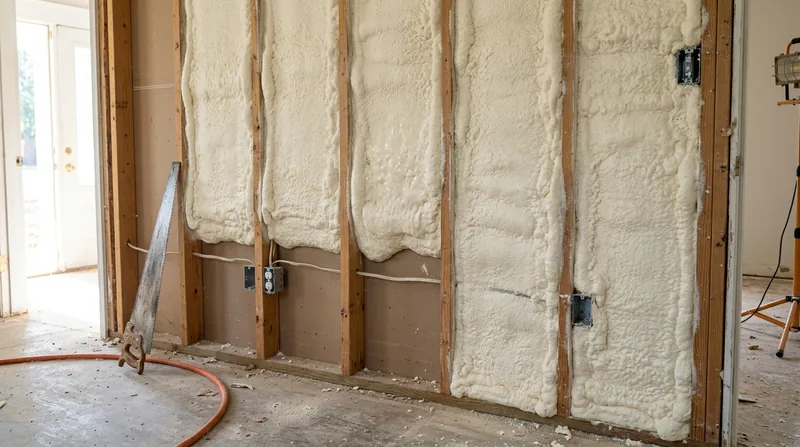




Open Cell Spray Foam Insulation in Fayetteville solves the most common insulation failure in this region: hot, humid attics that sit 130 to 150 degrees in summer, with vented crawl spaces below pulling moisture up through band joists and rim beams. The Sandhills climate and the building stock that dominates here (1950s brick ranches with flattened attic fill, 1980s-2020s two-stories with finished rooms over garages, and older frame houses on brick piers) all demand air sealing that fiberglass alone cannot deliver. Half-pound open-cell foam air-seals at a fraction of the cost of closed-cell while delivering the same acoustic benefit between rooms and between duplex units. We spell out where it belongs, and where a crawl space or flood-prone floor calls for closed-cell spray foam instead.
Why Open-Cell Foam Works in Fayetteville's Humid Summer Climate
Fayetteville sits where the Piedmont meets the coastal plain, and that geography brings a long, wet summer. Most attics here are vented, which means hot outside air and the moisture it carries gets pulled in through soffit vents, then radiates off the roof deck into the attic cavity. Fiberglass stops neither the air movement nor the moisture. Open-cell foam air-seals the attic floor and any rim joists, stopping the convection loop. It also absorbs and releases moisture slowly, which keeps humidity swings from collapsing into condensation on cold surfaces during shoulder seasons.
- Open-cell foam air-seals attic floors and band joists without the cost premium of closed-cell, bringing energy costs down on homes with vented attics.
- The material absorbs sound between rooms and between duplex units, a major selling point in military rental stock around Fort Bragg and Hope Mills.
- At half a pound per cubic foot, it expands fully and conforms to irregular framing, joists, and rim geometry in older Haymount and mill-village homes.
- Moisture tolerance is higher than fiberglass, which matters in a climate where humidity runs 70 to 80 percent for half the year.
The trade-off is R-value per inch: open-cell runs roughly 3.5 to 3.6 per inch, while closed-cell delivers 6 to 7. For an attic in Fayetteville, that means a thicker application, but the per-board-foot cost is lower and the air-sealing performance is identical.
Key info: A 1950s brick ranch in Massey Hill or a 1980s two-story in the Cliffdale corridor will see the biggest comfort gain from open-cell attic foam, because both have vented attics and rim joists that leak air year-round. Older frame homes on brick piers in downtown Fayetteville benefit equally.
For guidance on whether your home is a candidate, call (472) 263-8386 for a free, no-obligation estimate with R-value and thickness specs included.
How We Install Open-Cell Spray Foam in Fayetteville Attics and Walls
Open-cell foam installation starts with a site walk to identify air leaks, measure the attic cavity or wall cavity, and confirm substrate condition. We do not spray over wet, contaminated, or leaking surfaces. If we find active moisture, a roof leak, or a crawl space with standing water, we walk away or we fix the moisture first. The spray itself takes one to two days depending on attic size and complexity. The material cures to full strength in 24 to 48 hours, and we specify a mechanical ventilation plan during that window to manage off-gassing.
- We inspect the attic or wall cavity and confirm the substrate is dry and sound before any foam is applied.
- We set up spray equipment with proper drum temperature and mix ratio verified by the manufacturer.
- We apply open-cell foam in controlled passes, measuring thickness and board-foot density to meet code and the R-value promised in your estimate.
- We seal all thermal and ignition barriers per the building code in force at your address and deferred to your local building department.
- We leave the site clean, with a written record of R-value, thickness, and the re-entry window specified.
The entire process is straightforward and transparent. We also offer insulation removal if your attic holds failed fiberglass or old cellulose that needs to come out first.
Local example: A Cape Fear mill village home in Lumberton with a vented attic and no rim joist seal will have us remove the old fiberglass, air-seal the band joist first, then spray the attic floor to R-38. A finished room over the garage in Spring Lake gets the same treatment plus open-cell in the FROG ceiling for sound control and thermal break. Both are standard Fayetteville jobs.
Open-Cell Spray Foam Installation Methods and Applications
| Method | Description | Best for |
|---|---|---|
| Attic floor spray | Spray open-cell directly onto attic floor joists and rim beams, sealing all air leaks and creating a thermal break between conditioned space and the vented attic above. | 1950s brick ranches, 1980s-2020s two-stories, and older frame homes with vented attics and no attic insulation or failed fiberglass. |
| Wall cavity injection | Inject open-cell foam into empty wall cavities through small holes drilled in exterior sheathing or interior drywall, filling voids without demolition. | Massey Hill and downtown Fayetteville frame homes with lap siding and no insulation, and pre-1980 stock where retrofit without tearing down walls is required. |
| Finished room over garage (FROG) | Spray open-cell on the FROG ceiling and rim to create thermal break and sound dampening between the unconditioned garage below and the living space above. | 1980s-2020s two-stories in Cliffdale, Hope Mills, Spring Lake, and Raeford where the FROG is a military rental liability and comfort is a turnover issue. |
| Rim and band joist seal | Spray open-cell on rim joists and band beams where the foundation meets the house frame, sealing the air leak path that pulls humid crawl space air into the attic. | All Fayetteville homes on brick piers or vented crawl spaces, especially mill villages and Haymount where crawl space moisture is the dominant failure mode. |
Each method is measured on site and quoted with R-value and thickness included in the estimate. We do not use one-size-fits-all pricing.
Open Cell Spray Foam Insulation Cost in Fayetteville: What to Expect
Open-cell spray foam costs less per board foot than closed-cell, but the total job cost depends on attic size, wall cavity footage, and the extent of air sealing required. A typical attic in a 1950s brick ranch or a 1980s two-story in Fayetteville runs between $2,500 and $6,000 for full attic floor coverage with rim joist sealing included. A wall cavity retrofit or a FROG ceiling will land lower, typically $1,500 to $3,500. The price per board foot starts at around $0.55, but access, substrate prep, and the complexity of the framing all move that figure.
The best way to know what your home will cost is to get a site estimate with R-value and thickness spelled out. We measure the cavity, calculate the board feet, and give you a fixed price before we spray. For a detailed breakdown of pricing across all our services, see our full pricing overview.
Why does getting 2 or 3 estimates matter? Because a contractor who quotes you without showing up, without measuring, or without specifying R-value and thickness is guessing. Honest estimates are site-specific and include the numbers that prove the work was done right.
Open Cell Spray Foam Insulation Near Me: What Fayetteville Homeowners Should Know When Hiring
Hiring a spray foam contractor is not the same as hiring a tree service or an HVAC company. The trade has its rig-and-run crews (an out-of-state trailer, a job sprayed in an afternoon, nobody reachable when the smell won't go away) and its national franchises. The local independent is your best bet, because we are reachable, we know the local code, and we are accountable. Here is what to verify before you sign a contract.
- Confirm the contractor is fully insured and ask to see a certificate of insurance that names your address as a location of work.
- Ask for at least three references from homes or buildings in Fayetteville or nearby cities, and call them to ask about smell, timeline, and whether the contractor showed up if issues came up after the job.
- Get a written estimate that includes R-value per inch, total thickness, board-foot calculation, and the re-entry window specified by the manufacturer.
- Verify whether your city or county requires a permit for attic or wall insulation work, and ask the contractor to help you navigate what applies at your address.
- If your home is in an HOA or a historic district, check your architectural guidelines before booking, because some communities have rules on exterior work or visible foam on metal buildings.
A contractor who cannot or will not show you insurance, cannot name references, and will not put R-value and thickness in writing is not worth the risk. Call us at (472) 263-8386 or visit our contact page for a free estimate with all the numbers included. We have been in business since 2012 and we are here to answer questions before, during, and after the work is done.
Open Cell Spray Foam Insulation in Fayetteville: Pricing Guide
| Service | Price | Details |
|---|---|---|
| Attic floor spray (open-cell) | Starting at $0.55/board ft | Includes R-value and thickness specs. Cost moves up with attic size, access difficulty, and rim joist complexity |
| Wall cavity injection (open-cell) | Starting at $0.55/board ft | Retrofit of empty wall cavities without demolition. Pricing depends on cavity footage and drilling access from exterior or interior |
| Finished room over garage (FROG) ceiling | Starting at $0.55/board ft | Sound dampening and thermal break between garage and living space. Includes rim seal and mechanical ventilation during cure |
| Rim joist and band joist seal | Starting at $0.55/board ft | Air sealing of the foundation-to-frame connection. Cost depends on linear footage and crawl space access |
| Insulation removal before foam spray | On estimate | If old fiberglass or cellulose must be removed first, pricing depends on volume and disposal logistics |
| Estimate and travel | Free | No obligation, no charge for site visit. Response within 24 hours at (472) 263-8386 for Fayetteville and surrounding service areas |
Indicative pricing, the exact cost depends on square footage, finish, and site access. Free personalized estimate within 24h at (472) 263-8386.


