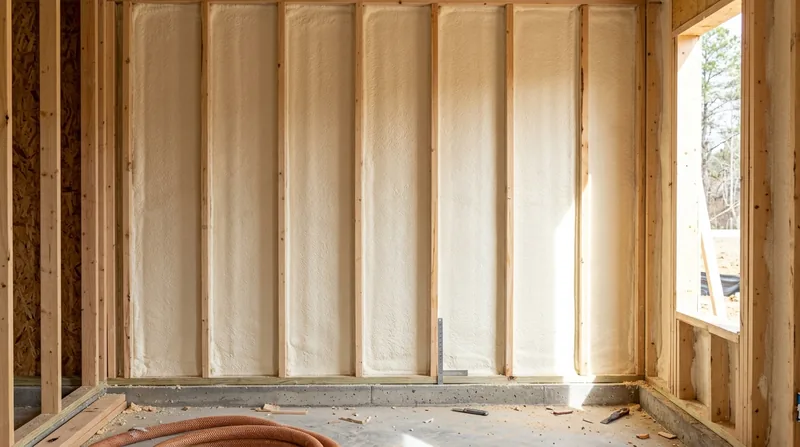




Fayetteville's humid subtropical climate and sandy Sandhills terrain create relentless moisture pressure on homes built on brick piers over vented crawl spaces and in attics that bake at 130-150°F through long summers. Whether you own a 1920s bungalow in Haymount, a mill village frame house with empty wall cavities, a 1950s brick ranch with flattened original attic fill, or a 1980s-2020s two-story with a finished room over the garage, closed cell spray foam insulation delivers the vapor barrier, structural stiffening, and flood resilience that open cell foam and fiberglass cannot match. Two-pound closed-cell foam gives you R-6.5 per inch with its own vapor retarder, shrugs off water intrusion, and controls the condensation that turns metal buildings, poultry houses, and crawl space walls into rust factories. We've been spraying closed-cell foam in Greater Fayetteville since 2012, and we know exactly where moisture wins in this region and how to seal it out.
Why Closed Cell Spray Foam Matters in Fayetteville's Humid Climate
Fayetteville sits where the Piedmont meets the coastal plain, and that geography means homes here face moisture from below (sandy soil, high water tables, crawl space humidity) and from above (hurricane-driven rain, long muggy summers). Fiberglass and cellulose absorb water and lose R-value when wet. Open-cell foam is vapor-open and invites condensation into wall cavities and attics. Closed-cell foam with its built-in vapor retarder stops that cycle cold. The structural rigidity also matters: a poultry house or metal building without closed-cell foam weeps condensation in summer and winter, rusting steel and rotting wood framing. Crawl space walls sprayed with closed-cell foam stay dry even after a hurricane surge, and the thermal break keeps rim joists from becoming ice dams.
- Closed-cell foam delivers R-6.5 per inch with a built-in vapor retarder, eliminating the need for a separate polyethylene sheet.
- The material shrugs off flood water and humidity without losing R-value or supporting mold growth.
- Structural stiffening from closed-cell foam reinforces rim joists, band joists, and attic decks against wind and racking loads.
- Metal buildings and poultry houses sprayed with closed-cell foam stop condensation drip that corrodes steel and rots fasteners.
- Crawl space walls stay dry and protected even during Carolina hurricanes and Cape Fear River flooding.
In a region where moisture is the dominant failure mode, closed-cell foam is the technical answer that pays for itself in durability and peace of mind.
Key info: After hurricanes Matthew (2016) and Florence (2018), Lumberton and the Cape Fear valley learned that crawl space walls need to be sealed tight and drained fast. Closed-cell foam on the walls stops water from wicking into rim joists and band joists, and the vapor barrier keeps humidity from creeping into the framing even after the water recedes.
For more detail on how we approach attic and crawl space work, see our crawl space spray foam insulation page.
How We Install Closed Cell Spray Foam in Fayetteville Homes and Buildings
Closed-cell foam is sprayed at a specific ratio and drum temperature, applied in controlled passes to hit the target thickness, and requires mechanical ventilation during cure. The process is not a one-afternoon job, and it is not a DIY product. We arrive with a rig, a sprayer, and a crew trained to meter the material correctly, watch for ratio drift, and keep the substrate dry. Cure time is twenty-four to forty-eight hours before the space is safe to re-enter. We do not promise same-day occupancy, and we do not spray over wet, contaminated, or leaking substrates. If the moisture comes first, we fix that or we walk away.
- We inspect the substrate and air seal any major gaps, cracks, or penetrations before we spray.
- We set up mechanical ventilation to exhaust VOCs during the cure window.
- We apply closed-cell foam in multiple passes, holding drum temperature and ratio steady to hit the design thickness and density.
- We measure the board-foot coverage on site and provide a written estimate with R-value and thickness specs before we start.
- We respect the twenty-four to forty-eight hour cure window and provide clear re-entry guidance.
The result is a durable, moisture-tight thermal envelope that lasts decades and does not sag, absorb water, or lose R-value over time.
Example: A metal building in Spring Lake used for equipment storage was dripping condensation in summer and winter, rusting tools and rotting the wooden roof deck. We sprayed the roof cavity and the rim with two-pound closed-cell foam, creating a sealed, insulated envelope. No more drip. The owner reclaimed the space and cut humidity by 40 percent in the first month.
Learn more about our air sealing approach on our air sealing page.
Closed Cell Spray Foam Applications and Techniques
| Application | Why Closed Cell | Key Benefit in Fayetteville |
|---|---|---|
| Crawl space walls | Vapor retarder stops moisture from wicking into rim joists and band joists; flood resilient. | Protects foundation framing from Cape Fear humidity and hurricane surge water. |
| Metal building and poultry house walls and roof | Vapor barrier on warm side stops condensation drip; structural stiffening braces thin steel. | Eliminates condensation rust and drip that corrodes fasteners and rots framing in humid summers. |
| Sealed or unvented attic decks | Creates conditioned attic; R-6.5/inch reaches code with modest thickness; vapor barrier prevents moisture from rising into the deck. | Lets you move HVAC ducts into conditioned space and eliminate the 130-150°F attic loss. |
| Wall cavities (retrofit injection) | Fills empty cavities in pre-1980 frame houses without demolition; vapor barrier built in. | Seals Massey Hill mill villages and Cape Fear mill cottages without tearing out lap siding. |
| Rim and band joists | Thermal break plus vapor barrier; structural stiffening prevents racking and air leakage. | Stops heat loss at the foundation perimeter and prevents ice dams on brick pier homes. |
Closed Cell Spray Foam Insulation Cost in Fayetteville: What to Expect
Closed-cell spray foam is priced by the board foot (a board foot is one square foot at one inch thick). Starting rates in Fayetteville run from $1.20 to $1.60 per board foot, depending on the thickness you need, the substrate condition, and site access. A crawl space wall at 2 inches thick costs less per linear foot than a sealed attic deck at 5 inches thick, but the R-value per dollar is the same. A poultry house or metal building with structural demands may call for 3 or 4 inches, which raises the material cost but delivers the condensation control and stiffening you cannot get elsewhere. We measure the job on site, calculate the exact board-foot count, and provide a written estimate with R-value and thickness specs before you commit. Travel is included in Fayetteville and surrounding areas, no separate mileage fee.
Factors that move the price up include complex geometry (multiple roof planes, angled ceilings, lots of obstructions), difficult substrate access (interior spraying in occupied homes, tight crawl spaces, high attics), and any substrate prep or insulation removal required before we spray. A straightforward crawl space wall or a sealed attic deck in good condition will run closer to the floor; a retrofit job in a 1920s bungalow with old fiberglass, settling, and uneven framing will cost more because we have to prep and remove first.
Always get 2 or 3 estimates. A price far below market with no detail on thickness, R-value, or inspection is a warning flag. We provide a full pricing overview that covers the common jobs and shows you what to expect. Call us at (472) 263-8386 for a free, no-obligation estimate within 24 hours.
What to Look for When Hiring a Spray Foam Insulation Contractor Near Fayetteville
The spray foam trade has rig-and-run crews (out-of-state trailers, one-day jobs, nobody reachable when the smell lingers) and it has national franchises with high overhead. A local independent contractor with a local address, local plates, and a phone number that rings in Fayetteville is positioned differently from both. Here is what to verify before you hire any spray foam installer, including us.
- Ask for proof of full insurance coverage and request a certificate of insurance naming your address.
- Get a written estimate that includes R-value, thickness in inches, and a board-foot count measured on site.
- Check references from completed jobs in Fayetteville, Hope Mills, Spring Lake, or Raeford, and ask about cure time and re-entry guidance.
- Verify that the contractor plans mechanical ventilation during cure and respects a twenty-four to forty-eight hour re-entry window.
- Confirm that the contractor will not spray over wet, contaminated, or actively leaking substrates, and will address moisture first if needed.
- For attic work, clarify whether permits apply at your address and who handles the permit application; the building official, not the contractor, decides what is required.
- If your home is in an HOA or a historic district, ask whether the work touches the exterior or requires architectural approval.
A contractor who walks away from a wet crawl space or a leaking roof is not dodging the job; they are protecting you from a failed installation. Honest guidance on when closed-cell foam is right and when a cheaper option is the right answer is the differentiator between a shop that builds trust and one that chases every dollar.
Ready to move forward? Contact us for a free estimate and we will walk you through the process, answer your questions, and provide a written quote within 24 hours.
Closed Cell Spray Foam Insulation in Fayetteville: Pricing Guide
| Service | Price | Details |
|---|---|---|
| Crawl space walls (2 inches) | From $1.20/board ft | Vapor barrier and flood protection on foundation walls; linear footage and height determine total board feet |
| Sealed attic deck (4-5 inches) | From $1.35/board ft | Reaches code R-value; square footage and design thickness are measured on site; complex roof geometry increases labor |
| Metal building or poultry house (3-4 inches) | From $1.45/board ft | Condensation control and structural stiffening; roof cavity and wall coverage; access and roof pitch affect crew time |
| Wall cavity retrofit injection (full depth) | On estimate | Pre-1980 frame houses without demolition; cavity depth and length determine board feet; substrate inspection required first |
| Insulation removal and closed-cell spray (combined) | On estimate | Removal of old fiberglass or failed foam adds labor; disposal and haul-off included; spray pricing follows standard board-foot rate |
| Free estimate and site visit | No charge | Written quote with R-value and thickness; response within 24 hours at (472) 263-8386; no obligation to book |
Indicative pricing, the exact cost depends on square footage, finish, and site access. Free personalized estimate within 24h at (472) 263-8386.


