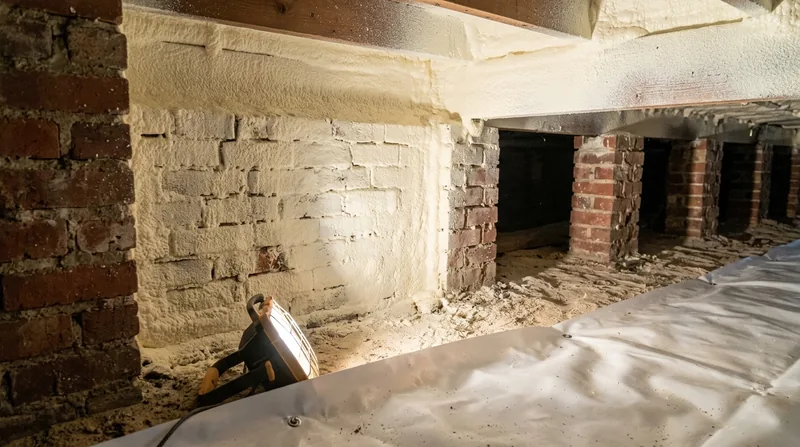




Crawl Space Spray Foam Insulation in Fayetteville stops humid air from rising into your home through the foundation. Fayetteville sits on sandy Sandhills soil, and the brick piers that hold up most of our homes create an open crawl space underneath where moisture pools year-round. The combination of long, muggy summers and high groundwater means crawl space walls and rim joists leak conditioned air and let humidity inside. Closed-cell foam seals those walls, holds back moisture, and keeps your air handler from working overtime. We install foam the right way: moisture is fixed first, the termite inspection strip your bond requires is left clear, and the work is done with controlled thickness and proper ventilation so you can re-enter safely in 24 to 48 hours.
Crawl space insulation is one of the highest-return jobs in the Fayetteville market because the problem is so common and the fix is so direct. A leaking crawl space pulls humid air into your attic ductwork, your living spaces, and your walls, and it drives up cooling costs all summer long. The sandy soil under Fayetteville homes drains fast after rain, but the water table stays high, and the brick piers that are standard here sit right at the boundary where moisture vapor rises. Closed-cell spray foam stops that vapor, holds the R-value even when damp, and gives you the control you need in our humid subtropical climate.
Why Crawl Space Moisture Is the Real Problem in Fayetteville
Humid air rising through an open crawl space is the single biggest energy leak in most Fayetteville homes. The brick piers that hold up our 1910s bungalows, our 1950s ranches, and our newer two-stories all sit on sandy soil where groundwater sits high and moisture vapor never stops rising. When that humid air reaches your attic ductwork or your rim joists, it cools, condenses, and soaks the insulation you already have. Wet fiberglass loses its R-value, mold spores find a home, and your air handler runs constantly trying to dehumidify a space that should never be wet in the first place.
- Humid air from the crawl space rises into your attic and cools around cold ductwork, losing its ability to hold moisture and condensing on fiberglass insulation.
- Moisture-soaked insulation loses R-value and creates an environment where mold and dust mites thrive, affecting indoor air quality.
- Your air handler and air conditioning system work overtime trying to dehumidify a space that foam sealing would have prevented from getting humid in the first place.
- Moisture vapor migrating into rim joists and band joists softens wood and creates conditions where termites and wood-boring insects find entry points your pest bond does not cover.
Sealing the crawl space walls with closed-cell foam stops that vapor rise before it starts, and it lowers your cooling load all summer long.
Key info: Homes in Hope Mills, Spring Lake, and Raeford built on brick piers over sandy soil see crawl space moisture problems within 5 to 10 years if the crawl space stays vented. Sealing the walls with closed-cell foam is the permanent fix and the one that actually gets verified by a home inspector when you sell.
How We Seal Your Crawl Space: The Process in Fayetteville
We start with an on-site inspection to map the crawl space, check for standing water or active moisture, and identify the rim joist and band joist areas where foam will have the biggest impact. If moisture is present, we address it first or we walk away. Once the crawl space is dry, we install closed-cell spray foam on the interior walls from the sill plate down, leaving the termite inspection strip your pest bond requires completely clear. We control the thickness on every pass, maintain the manufacturer's ratio and drum temperature, and run mechanical ventilation during cure so the space is safe to re-enter in 24 to 48 hours. The foam creates a continuous air seal that stops vapor, holds its R-value even in humid conditions, and gives you a crawl space that stays dry year-round.
- We inspect the crawl space for standing water, active leaks, or moisture problems that must be resolved before foam is applied.
- We apply closed-cell foam to the interior walls from the sill plate downward, building the thickness in controlled passes to meet the R-value your home needs.
- We leave the termite inspection strip required by your pest control bond completely unobstructed so future inspections can happen without cutting into foam.
- We ventilate the space mechanically during cure and provide a re-entry timeline so you know exactly when the crawl space is safe to use again.
- We leave the job clean and document the R-value and thickness so you have the specifications for your records and any future sale.
The result is a crawl space that stops humidity rise, lowers your cooling costs, and protects the structural integrity of your rim joists and band joists year-round.
Real example: A 1960s brick ranch in Massey Hill with lap siding over empty wall cavities and a vented crawl space had moisture rising into the attic every summer, and the fiberglass was gray with mold. We sealed the crawl space walls with 2 inches of closed-cell foam (R-13), left the termite strip clear, and the homeowner's cooling bills dropped 18 percent and the attic stayed dry all summer.
| Approach | Description | Best for |
|---|---|---|
| Closed-Cell Foam on Crawl Space Walls | High-density foam (1.5 to 2 lb/cf) sprayed to 2 to 3 inches on interior walls and rim joists, creating a vapor barrier and air seal. | Humid climates, sandy soil, homes where moisture rise is the primary issue, and where termite inspection access must be preserved. |
| Rim and Band Joist Foam | Closed-cell foam applied to the rim joist box where it sits on the foundation, sealing the thermal bridge and the air leak that connects crawl space to interior framing. | Any home with a vented crawl space, especially older homes where the rim joist is the primary source of air infiltration and moisture entry. |
| Partial Wall Sealing | Foam applied only to the rim joist and upper 12 to 18 inches of crawl space walls where moisture and air infiltration are most active. | Crawl spaces where full-wall coverage is not necessary, budget-conscious homeowners, and homes where moisture is seasonal rather than year-round. |
| Full Crawl Space Encapsulation with Foam | Closed-cell foam on all walls and rim joists, plus a vapor barrier on the floor, creating a fully sealed and conditioned crawl space. | Homes with chronic moisture problems, high water tables, or where the crawl space will be used for storage or mechanical equipment that requires dry conditions. |
Crawl Space Spray Foam Insulation Cost in Fayetteville: What to Expect
Crawl space foam starts at $2,500 to $4,500 for a typical 1,500 to 2,000 square foot home with 2 to 3 inches of closed-cell foam on the walls and rim joists. The actual cost depends on the linear footage of walls to be sealed, the thickness required by your climate and energy code, whether moisture removal is needed first, and how easily we can access the crawl space. A tight crawl space under a 1950s brick ranch costs less than a sprawling space under a newer two-story, and a crawl space with standing water or active leaks requires remediation before foam is applied, which adds to the timeline and the estimate. Get a detailed pricing breakdown by calling us at (472) 263-8386 with your home's square footage and zip code, and we will give you a range before we schedule the site visit.
The best way to understand your cost is to get 2 to 3 estimates from contractors who measure the crawl space on site, specify the R-value and thickness in writing, and explain what is and is not included. A low-ball estimate with no R-value, no thickness spec, and no mention of moisture or ventilation during cure is a red flag. Our estimate is free, comes within 24 hours, and includes the square footage, the R-value, the foam thickness, and a timeline so you know exactly what you are paying for.
Contact us for a free estimate and we will walk you through the cost, the timeline, and the long-term return on the job.
Crawl Space Spray Foam Insulation Near Me: What Fayetteville Homeowners Should Know When Hiring
When you are looking for a spray foam contractor to seal your crawl space, verify that they are fully insured and that their insurance is active and verifiable by phone. Ask for at least two references from crawl space jobs completed in Fayetteville or nearby in the last 12 months, and call those homeowners to ask whether the work stayed dry, whether re-entry happened on the promised timeline, and whether the contractor was reachable after the job was done. Get the estimate in writing with the R-value, the thickness, the linear footage of walls, and the price clearly stated. Ask whether they will leave the termite inspection strip clear as required by your pest control bond, and get that commitment in writing as well. If your home is in a master-planned community, check your HOA rules to see whether exterior work on crawl space vents or foundation areas requires approval before work starts.
- Verify that the contractor carries active, verifiable liability insurance and can provide a certificate of insurance before work begins.
- Request written references from at least two crawl space jobs completed in Fayetteville in the past 12 months and follow up with those homeowners directly.
- Get the estimate in writing with R-value, thickness in inches, linear footage of walls, and the total price so you can compare apples to apples across contractors.
- Confirm in writing that the termite inspection strip required by your pest control bond will be left completely clear and unobstructed.
- Ask about the re-entry timeline and whether mechanical ventilation will be used during cure so you know when the crawl space is safe to use again.
The Fayetteville area has a mix of local independent insulation shops, regional franchises, and out-of-state crews that rig and run. The differentiator is honesty: a contractor who walks away from a wet crawl space, who specifies R-value and thickness in writing, and who is reachable after the job is done is the one you want. Call us at (472) 263-8386 for a free estimate and we will help you understand what your crawl space needs and what the job will cost.
Crawl Space Spray Foam Insulation in Fayetteville: Pricing Guide
| Service | Price | Details |
|---|---|---|
| Rim Joist and Band Joist Sealing | Starting at $1,200 | Closed-cell foam on the rim joist box and upper band area, 1.5 to 2 inches thick, leaving termite strip clear. |
| Partial Crawl Space Wall Sealing | Starting at $2,500 | Foam on rim joists and lower 12 to 18 inches of walls, typical for seasonal moisture control in 1,500 to 2,000 sq ft homes. |
| Full Crawl Space Wall Sealing | Starting at $4,000 | Closed-cell foam on all walls from sill plate down, 2 to 3 inches thick, with termite strip preserved, covers 1,500 to 2,000 sq ft homes. |
| Moisture Remediation Before Foam | On estimate | Standing water, active leaks, or drainage issues must be resolved before foam application; cost varies by severity and scope. |
| Travel and Estimate | Free estimate, included travel | No charge for on-site inspection and written estimate within 24 hours; travel included in Fayetteville and surrounding areas. |
Indicative pricing, the exact cost depends on square footage, finish, and site access. Free personalized estimate within 24h at (472) 263-8386.


