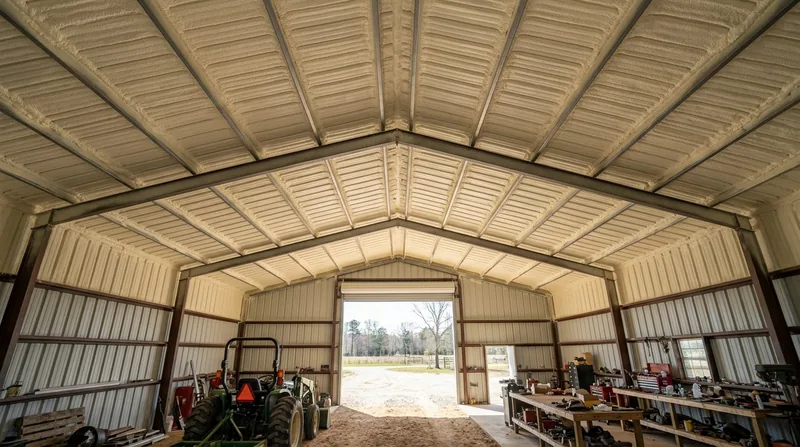




Metal building and barndominium spray foam insulation in Fayetteville stops the one problem that kills a metal structure in the Carolina Sandhills: condensation. When the sun bakes a steel roof to 140 degrees and then a summer storm drops the temperature 30 degrees in an hour, the metal sweats. That water pools on your concrete floor, rots your stored equipment, and turns a poultry house or farm workshop into a rust factory. Closed-cell spray foam, applied to the underside of the metal roof deck or the exterior walls of a metal-framed building, stops that cycle cold. It seals the air, insulates the steel, and keeps the interior dry. From the poultry operations in Sampson and Bladen County to the ag shops along the Harnett County roads, and from barndominiums rising in Spring Lake and Hope Mills to the old tobacco barns being retrofitted across the Cape Fear valley, metal buildings in the Fayetteville area run on closed-cell foam.
Fayetteville Spray Foam Insulation has sealed metal buildings since 2012. We know the difference between a barn that stays dry and one that doesn't. We spray to the thickness and R-value your building needs, and we stop the condensation at the root.
Why Metal Buildings Sweat in Fayetteville: The Condensation Problem That Foam Solves
Metal buildings are efficient to build and they span wide spaces without posts. But steel conducts temperature like a wire. On a humid summer morning in Fayetteville, the metal roof deck is already 120 degrees from the night before. A thunderstorm rolls in, the air temperature drops 30 degrees in minutes, and the metal surface drops faster still. The warm, moisture-laden air inside the building hits that cold steel and condenses. Water runs down the inside of the walls and pools on the floor. In a poultry house, that means dead birds and ruined litter. In a farm shop, it means rust on every tool and piece of equipment. In a barndominium, it means mold on the walls and a smell you cannot get rid of.
Closed-cell spray foam stops this cycle because it insulates the steel from the outside air temperature swing and because it seals every gap so no warm, moist air can reach the cold metal.
- Closed-cell foam bonds to the metal roof deck and creates a continuous thermal break between the interior and the steel.
- The foam seals air leaks around fasteners, seams, and panel overlaps where uninsulated buildings always sweat.
- The R-value and thickness we apply are sized to the climate and your building's use so the interior stays above the dew point even in the worst weather.
- Metal buildings in Sampson, Bladen, and Harnett County farmland run year-round without condensation when the foam is done right.
Condensation control is not a side benefit of metal building foam. It is the whole point.
Key info: A poultry house or farm shop in Sampson County that was sweating water every summer can be sealed with closed-cell foam for around 1.5 to 2.5 board feet per square foot of roof deck, depending on the existing ventilation and your target R-value. We write it down: thickness, R-value, and the re-entry window before you can occupy the space.
The North Carolina Department of Environmental Quality and the local building departments in Fayetteville and the surrounding counties do not regulate the application of spray foam to metal buildings as heavily as they do attic work, but they do track permits for structural modifications and new construction. Closed-cell spray foam is the insulation that meets code and stops the moisture.
How We Seal a Metal Building Against Condensation: The Spray Foam Process in Fayetteville
Sealing a metal building starts with understanding what you are protecting. A poultry house, a farm shop, or a barndominium in Hope Mills or Raeford has different moisture loads and different use patterns. We walk the building, measure the roof deck, check for existing ventilation or air gaps, and ask what the building is for. Then we write an estimate that specifies the foam type, the thickness per pass, the total R-value, and the re-entry window. We do not spray until you understand what you are paying for.
The spray itself is methodical. We mask off the areas where foam should not go, we set up mechanical ventilation to move the off-gassing out of the building, and we spray the foam in controlled passes so it cures at the right thickness. Closed-cell foam cures in 24 to 48 hours. During that time, the building is not occupied. After cure, the foam is inert, it does not off-gas, and it stays put for the life of the building.
- We inspect the roof deck and walls for gaps, rust, or damage that has to be addressed before foam goes down.
- We apply a primer or sealant to any bare metal so the foam bonds correctly and does not fail at the interface.
- We spray the closed-cell foam in multiple thin passes, never one thick pass, so it cures evenly without voids or thin spots.
- We run fans during the cure to move fumes out and ensure the foam sets up at the right density and R-value.
- We leave the building sealed and unoccupied for 24 to 48 hours, depending on temperature and humidity, then verify the cure before you re-enter.
The result is a metal building that does not sweat, does not rust, and holds its temperature.
Example: A 40 by 60 foot farm shop in Bladen County was losing equipment to rust every summer because the metal walls and roof were sweating water daily. We sealed the roof deck and the top 8 feet of the walls with 1.5-inch closed-cell foam. The interior stayed dry all the next summer. No more rust. No more smell. The shop stayed 10 degrees cooler because the foam also insulated it from the sun.
If you have an attic or a crawl space that also needs sealing, we can do that too. Air sealing works hand in hand with insulation to keep your whole building tight.
Metal Building Spray Foam Methods: Closed-Cell Versus Open-Cell, and When Each Works
| Approach | Description | Best for |
|---|---|---|
| Closed-Cell Spray Foam | High-density foam with an R-value around 6.5 per inch. Stops air and moisture. Cures hard and stays rigid. | Poultry houses, farm shops, barndominiums, and any metal building where condensation or humidity is the problem. The standard for metal buildings in the Fayetteville area. |
| Open-Cell Spray Foam | Lower-density foam with an R-value around 3.6 per inch. Flexible, absorbs sound, cheaper per board foot. Allows vapor to pass through. | Metal buildings where condensation is not the main problem and sound dampening matters more. Rarely the right choice for Fayetteville metal structures in humid climates. |
| Hybrid: Closed-Cell + Open-Cell | Closed-cell on the roof deck and upper walls to stop condensation, open-cell on interior walls for sound control and cost savings. | Large metal buildings where you need moisture control on the envelope but want the acoustic benefits of open-cell in the occupied space. |
| Retrofit Over Existing Insulation | Adding closed-cell foam over old fiberglass, mineral wool, or failed foam to seal air leaks and restore R-value without stripping. | Metal buildings where the original insulation is still in place but the building is still sweating. Insulation replacement can be done in stages. |
Closed-cell is the standard for metal buildings in Fayetteville because the humidity and the temperature swings are real. Open-cell has its place, but it does not stop condensation. If condensation is your problem, closed-cell is your answer.
Metal Building and Barndominium Spray Foam Cost in Fayetteville: What to Expect
Metal building spray foam costs depend on the size of the structure, the roof pitch and shape, the height and accessibility of the walls, whether you are spraying the deck, the walls, or both, and the R-value you need. Closed-cell foam runs from about $1.75 to $3.00 per square foot of roof or wall area, depending on thickness and local labor rates. A 40 by 60 foot farm shop with a 6-inch closed-cell roof deck and 2 inches on the upper walls typically runs $4,500 to $7,500. A barndominium in Hope Mills or Spring Lake with a sealed attic and vaulted ceilings may run higher because of the complexity of the spray pattern and the safety equipment needed to reach the peaks.
What moves the price up is access. If the building is in a tight lot with power lines overhead or trees close to the walls, the spray rig has to be positioned carefully and the crew has to work around obstacles. If the roof has rust, old sealant, or gaps that need repair before foam, that adds cost. If you want the walls sealed as well as the deck, that is more square footage and more labor.
The only way to know your cost is to get an on-site estimate. We measure the building, check the condition of the metal, ask what the building is used for, and write a price that includes the foam, the labor, the ventilation during cure, and the re-entry window. Our pricing page shows the range, but your building is unique. Call us at (472) 263-8386 for a free estimate with no obligation.
Two to three estimates from different contractors are worth your time. Make sure each one specifies the R-value, the thickness, and the product being used. A low price with no detail is a red flag. An estimate that does not mention the re-entry window or the cure time is another one.
What to Look for When Hiring a Metal Building Spray Foam Contractor Near Fayetteville
Finding the right spray foam contractor for your metal building is not the same as hiring a general contractor. Spray foam is a chemical process, not a carpentry job. The installer has to understand the product, the application technique, the cure conditions, and the safety protocols. A bad spray foam job can smell for weeks, fail to stop condensation, or create a liability if the work is not documented and insured.
Start by asking any contractor you call whether they have insurance and whether they can provide a certificate. Ask for references from metal building jobs they have done in the last two years. Ask what their re-entry policy is. Do they tell you to stay out for 24 to 48 hours, or do they promise you can go back in the same day? If they promise same-day re-entry, they do not understand the product.
Ask for a written estimate that includes the foam type, the thickness per pass, the total R-value, the square footage being sprayed, and the price. If an estimate is vague or quoted per board foot without a thickness specified, that is a sign the contractor does not know what they are doing. Ask whether they will remove old insulation if it is damaged or failed. Insulation removal is sometimes necessary before the new foam goes down.
If your metal building is in a master-planned community or an HOA area in Spring Lake, Raeford, or the Cliffdale corridor, ask whether the HOA has rules about exterior work or insulation. Most HOAs do not regulate insulation, but some do require approval for work on the outside of the structure. Check before you book.
Finally, verify that the contractor will provide mechanical ventilation during the cure and that they will tell you when the building is safe to re-enter. A professional spray foam installer treats the cure window as a safety issue, not a suggestion. Contact us for a free estimate and a walk-through of what the job will look like.
Metal Building & Barndominium Spray Foam in Fayetteville: Pricing Guide
| Service | Price | Details |
|---|---|---|
| Closed-Cell Metal Roof Deck | Starting at $1.75/sq ft | 1 to 1.5 inches applied, R-value 6 to 10, condensation control for farm buildings |
| Closed-Cell Metal Walls (Upper Section) | Starting at $1.50/sq ft | 1 to 2 inches on walls up to 8 feet, stops air leaks and moisture at seams and fasteners |
| Full Enclosure (Roof + Walls) | Starting at $1.75/sq ft | Entire metal building sealed for complete condensation control, size and pitch affect final number |
| Retrofit Over Existing Insulation | On estimate | Cost depends on condition of old material, whether removal is needed, and accessibility for spray rig |
| Travel and Mobilization | Included | No separate charge for Fayetteville, Hope Mills, Spring Lake, Raeford, Lumberton, or surrounding service areas |
| Free Estimate | No charge | Written with R-value, thickness, and square footage specified, response within 24 hours at (472) 263-8386 |
Indicative pricing, the exact cost depends on square footage, finish, and site access. Free personalized estimate within 24h at (472) 263-8386.


