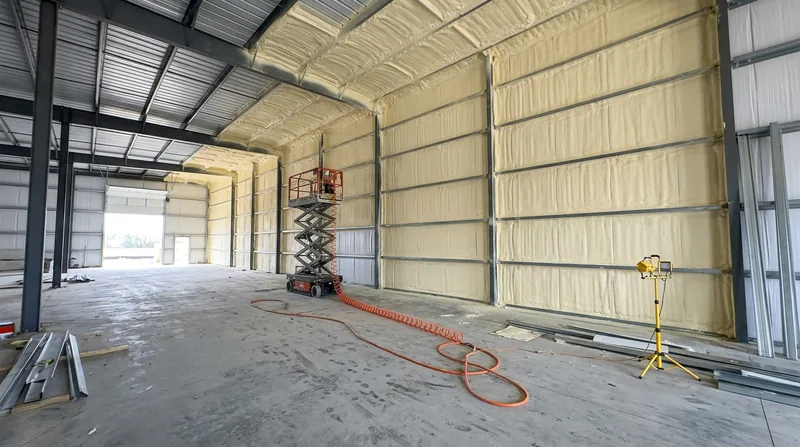




The Interstate 95 warehouse belt and fast-growing commercial corridors around Fort Bragg demand insulation that works on schedule and passes local inspection. Commercial and new construction spray foam in Fayetteville keeps your operation running during phased construction, controls condensation on metal shells, and delivers code-compliant assemblies with documentation your inspector will accept. Whether you are finishing a warehouse, insulating a new office, or sealing a production facility, spray foam closes air leaks and thermal gaps that fiberglass and blown-in cannot touch. The humid subtropical climate and year-round construction cycle mean your building envelope must work immediately and keep working through long muggy summers and hurricane-season moisture. We have served Fayetteville, Hope Mills, Spring Lake, and the Cape Fear corridor since 2012, scheduling around your construction timeline and delivering documentation that local building departments actually accept.
Why Commercial and New Construction Spray Foam Matters in Fayetteville's Building Market
Fayetteville's commercial real estate sits in the humid Sandhills where moisture and temperature swings drive insulation failure. Metal buildings, warehouse shells, and multi-story residential construction around Fort Bragg turn over fast, and every phase must meet local code without delay. Spray foam seals the thermal envelope in a single pass, eliminates thermal bridging through metal studs and roof decks, and controls the condensation that pools inside uninsulated metal buildings during humid summers. New construction builders and property managers need insulation that installs on schedule, requires no follow-up air sealing, and produces the documentation your local building department requires before final sign-off.
- We seal the entire thermal envelope in one application, eliminating gaps that fiberglass cannot reach.
- Closed-cell foam controls condensation inside metal roofs and walls during humid weather and prevents moisture damage.
- Open-cell foam insulates at lower cost for interior walls and sound control in multi-story residential construction.
- We remove old insulation and spray on schedule, phased to your construction timeline and final inspections.
- Documentation includes R-value and thickness specifications for every section, written to local code language.
Code compliance and schedule reliability are the only guarantees that matter on a commercial job, and that is what we deliver.
Key info: North Carolina building code and local amendments govern attic ventilation, ignition barriers, and thermal barrier placement. Your local building department in Fayetteville, Hope Mills, or Lumberton sets the rules for your address. We help you understand what applies and deliver documentation that satisfies the inspector on the first visit.
How We Spray Commercial and New Construction Foam on Your Schedule
Commercial projects demand precision timing and zero disruption to your operation. We work with your general contractor or construction manager to schedule spray days around material deliveries, framing completion, and final inspection windows. Closed-cell foam cures in 24 hours and is ready for the next trade. Open-cell foam is lighter and faster for interior walls where condensation is not a concern. We set up mechanical ventilation during cure, manage VOC offgassing, and document the re-entry window so your crews and inspectors know when the space is safe.
- We visit the job site during framing to measure dimensions, assess substrate condition, and confirm the foam type and thickness required by your local code.
- We schedule spray to fit your construction calendar, typically between roof deck installation and interior wall closure.
- We set up mechanical ventilation, spray to the specified thickness in controlled passes, and manage cure time.
- We remove temporary ventilation once cure is complete and provide written documentation of coverage and R-value by section.
- Your inspector receives a copy before final sign-off, and we remain available for any questions about installation.
The result is an insulated building that passes inspection and performs from day one, with no surprises and no schedule delays.
Example: A 40,000-square-foot warehouse shell on the Interstate 95 corridor in Lumberton receives 4 inches of closed-cell foam on the roof deck and 2 inches in the rim joist. Spray takes three days, cure is complete in 24 hours, and the building is ready for HVAC rough-in. Documentation goes to the local building department by the end of the week.
See our approach to closed-cell spray foam insulation and open-cell spray foam insulation for details on how each product performs in your building type.
Spray Foam Methods and Applications for Commercial and New Construction
| Approach | Description | Best for |
|---|---|---|
| Closed-cell roof deck spray | High-density foam applied 3 to 4 inches thick on metal or wood roof decks, creating a fully adhered air seal and vapor retarder. | Metal buildings, warehouses, and sealed attics where condensation control and thermal bridging elimination are critical. |
| Open-cell wall cavity spray | Low-density foam applied 3.5 to 5.5 inches in exterior wall cavities, sealing air leaks while allowing interior vapor diffusion. | New residential construction, multi-family buildings, and retrofit walls where cost and sound dampening matter. |
| Rim and band joist closure | 2 to 3 inches of closed-cell foam applied to the band joist and rim cavity, sealing the thermal break and stopping air infiltration. | New construction on raised foundations, where the band joist is exposed and uninsulated during framing. |
| Metal building wall and roof | Closed-cell foam spray applied to the interior of metal studs and purlins, adhering directly to the metal and eliminating condensation contact. | Poultry houses, hog barns, metal shops, and production facilities where condensation drip and thermal loss are constant problems. |
Commercial and New Construction Spray Foam Cost in Fayetteville: What to Expect
Commercial spray foam pricing depends on building size, roof pitch, substrate condition, foam type, and thickness required by your local code. A free commercial estimate is your starting point. We measure the job on site, confirm the foam type and R-value your code requires, and provide a written proposal with board-foot quantity and total cost before any work begins. Metal buildings and sealed attics typically run higher than simple wall cavities because the surface area is larger and access may require temporary scaffolding. New construction jobs often run smoother than retrofits because the substrate is clean and the building is empty.
Factors that move the price up include difficult access (multi-story buildings, steep pitches, confined spaces), substrate preparation (removal of old insulation, cleaning, repair of damaged decking), and the foam type (closed-cell runs higher than open-cell but is required for condensation control on metal). Getting 2 to 3 estimates from local contractors is smart practice. Compare the R-value and thickness specified, the timeline, and the documentation you will receive. The lowest price often comes with the lowest detail, and the highest price does not guarantee better work. The middle ground, with clear documentation and a local address, is where the value lives.
See our pricing overview for typical ranges and what drives the estimate up or down. Call us at (472) 263-8386 for a free commercial estimate with no obligation to book.
What to Look for When Hiring a Spray Foam Contractor Near Fayetteville
The spray foam market in Fayetteville carries both local independents and out-of-state crews that spray and move on. A contractor that is fully insured, has a local address, and provides written estimates with R-value and thickness specifications is your baseline. Ask for references from other commercial jobs, not just residential work. Verify that the contractor understands your local building code and can deliver documentation that your inspector will accept without questions. Check whether the contractor manages its own equipment and crew or subcontracts the spray work, because that affects quality control and accountability.
- Request a written estimate that specifies foam type, R-value per inch, thickness, total board feet, and cost before any commitment.
- Ask whether the contractor pulls permits or helps you navigate what your local building department requires at your address.
- Verify that the contractor carries full insurance and can provide a current certificate of insurance naming your project as additional insured.
- Confirm the contractor's plan for mechanical ventilation during cure and the re-entry window before your next trade moves in.
- Check references from other commercial or new construction projects, not just attic jobs, to understand the contractor's experience at your scale.
The local independent contractor with a track record in Fayetteville, Hope Mills, and Lumberton is your safest choice because you can reach them when questions arise and they understand the local inspector's expectations.
Contact us at fayetteville-spray-foam-insulation.com/contact/ or call (472) 263-8386 to discuss your project and schedule a free commercial estimate.
Commercial & New Construction Spray Foam in Fayetteville: Pricing Guide
| Service | Price | Details |
|---|---|---|
| Free commercial estimate | Free | Site visit, measurement, foam type and thickness consultation, written proposal with R-value and board-foot quantity |
| Closed-cell roof deck spray | Starting at $1.50 per board foot | High-density foam 3 to 4 inches on metal or wood decks, includes mechanical ventilation and cure management during installation |
| Open-cell wall cavity spray | Starting at $0.85 per board foot | Low-density foam 3.5 to 5.5 inches in wall cavities, lower cost than closed-cell, ideal for residential construction and retrofit walls |
| Metal building or warehouse shell | On estimate | Large-scale projects require on-site measurement and local code confirmation before pricing, phased work keeps operation running |
| Travel and scheduling | Included | No separate mileage or travel fee in Fayetteville and surrounding service areas, coordination with your construction timeline at no extra cost |
| Documentation and inspection | Included | Written R-value and thickness specifications for every section, provided to your local building department for final sign-off |
Indicative pricing, the exact cost depends on square footage, finish, and site access. Free personalized estimate within 24h at (472) 263-8386.


