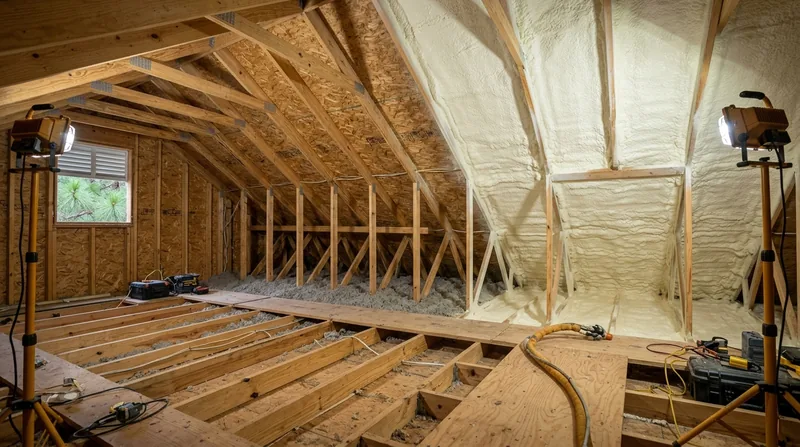




Insulation Replacement & Re-Insulation in Fayetteville is the full reset when old insulation has failed. Fayetteville sits in the North Carolina Sandhills where homes built on brick piers over sandy soil, or on slabs with vented attics that bake at 130-150°F through long humid summers, face a relentless moisture and thermal load. Insulation flattens under its own weight, gets fouled by rodents, or soaks through when a roof leak goes unnoticed. When that happens, patching does not work. We remove the old material, seal the air gaps that let conditioned air escape, and install new foam to current code R-values. The result is a home that actually holds temperature, stops the attic from driving your cooling costs, and stops moisture from migrating through crawl spaces and rim joists where it breeds mold and rot. This is the work that matters most in this climate.
Why Insulation Replacement Matters in Fayetteville's Hot, Humid Climate
The Sandhills climate is the enemy of old insulation. Summer heat pushes attic temperatures to 130 degrees or higher, fiberglass loses its loft, and moisture from the humid subtropical air migrates downward through vented attics and into crawl spaces. In Massey Hill and the mill villages, homes with lap siding over empty wall cavities and original flattened attic fill from the 1950s have lost 40 percent of their insulation value. Fort Bragg drives turnover, and rental properties in Hope Mills, Spring Lake, and Raeford often cycle through tenants every military move with no insulation maintenance. Hurricanes Matthew in 2016 and Florence in 2018 soaked attic insulation across Lumberton and the Cape Fear valley. When insulation fails, energy bills climb, humidity stays high indoors, and the structural wood begins to rot. Replacement stops the damage and restores comfort.
- We remove all old, flattened, or water-damaged insulation down to the deck.
- We seal air leaks around penetrations, band joists, rim joists, and ductwork with spray foam.
- We install new closed-cell or open-cell foam to the R-value required by current code.
- We verify coverage and thickness on site, and document the work with photographs and written specifications.
The result is a home that stays cool in summer, holds heat in winter, and stops moisture from driving utility costs and rot.
Key info: A 1960s ranch in Bonnie Doone with original flattened attic fill and no air sealing will lose 30 to 40 percent of its cooling capacity to the attic. Replacement with closed-cell foam and rim joist sealing restores that capacity and stops the humid air from entering the crawl space below.
For more detail on how moisture and heat drive insulation failure, see our Attic Spray Foam Insulation page.
How We Replace and Re-Insulate: Step by Step in Fayetteville
Replacement insulation is a planned project, not a patch. We start with a site inspection to understand what is failing, why it failed, and what code applies at your address. We then schedule the removal, which is the messy part and the part that cannot be skipped. Old fiberglass or cellulose comes out in a dumpster. We inspect the deck, rim joists, and band joists for moisture, mold, or structural damage. We identify air leaks: gaps around flue pipes, ductwork, electrical boxes, soffit vents, and the band joist where the foundation sits. We seal those gaps with spray foam. Then we install new insulation to specification, control the thickness and density on every pass, allow proper cure time, and document the work before you re-enter the space.
- We inspect the attic, crawl space, or wall cavity and assess what is failing and why.
- We remove old insulation, debris, and any nesting material, and haul it away.
- We seal air leaks with spray foam at the rim joist, band joist, penetrations, and ductwork.
- We install new closed-cell or open-cell foam to the R-value and thickness specified by code.
- We allow mechanical ventilation during cure and a 24 to 48 hour re-entry window before the space is used.
A typical attic replacement in a Fayetteville ranch takes two to three days from removal to finished foam and air sealing.
Example: A 1980s two-story in the Cliffdale corridor with a finished room over the garage (the FROG) had its original attic insulation compressed to 2 inches over 30 years. Summer cooling ran 18 hours a day. We removed the old fiberglass, sealed the rim joist and the ductwork with closed-cell foam, and installed 5.5 inches of open-cell foam to R-19. Cooling runtime dropped to 10 hours a day, and the FROG stayed comfortable for the first time.
Learn more about Insulation Removal and why it is the foundation of every replacement job.
Replacement Methods: Closed-Cell, Open-Cell, and Injection Foam
| Method | Description | Best for |
|---|---|---|
| Closed-Cell Spray Foam | High-density foam with closed air pockets. R-value 6 to 7 per inch. Vapor barrier. Resists moisture and condensation. | Attics in humid climates, crawl spaces, rim joists, metal buildings, and any space where moisture control is critical. |
| Open-Cell Spray Foam | Low-density foam with open air pockets. R-value 3.5 to 4 per inch. Breathable. Absorbs sound. Lower cost per board foot. | Attic replacement where moisture is managed by ventilation, sound dampening in garages, and cost-conscious retrofits on sound structures. |
| Injection Foam Retrofit | Low-pressure closed-cell foam injected into existing wall cavities without demolition. Fills empty cavities in pre-1980 frame homes. | Massey Hill and mill village homes with lap siding over empty cavities. Restores wall insulation without interior or exterior demolition. |
| Blown-In Cellulose or Fiberglass | Dense-packed blown insulation. Lower cost than spray foam. No air sealing. Settles over time in humid climates. | Simple attic top-ups on sound structures with no air leaks. Not recommended as primary replacement in Fayetteville's humid climate. |
Closed-cell foam is the most common choice for full replacement in Fayetteville because it handles the humidity, stops air leakage, and lasts. Open-cell is the cost-friendly option when moisture is managed by ventilation. Injection foam is the only way to insulate existing walls without tearing them open.
Insulation Replacement & Re-Insulation Cost in Fayetteville: What to Expect
The cost of insulation replacement depends on the size of the space, the condition of the substrate, how much air sealing is needed, and whether you choose closed-cell or open-cell foam. A typical attic replacement in a Fayetteville ranch or two-story starts at around $2,800 and runs higher based on square footage, the amount of air sealing required, and the foam type. Crawl space replacement costs more because of access, moisture control, and the foundation work required. Wall injection foam in a Massey Hill mill house is priced per cavity foot and depends on the number of cavities and the wall height. We provide written estimates with R-value and thickness specifications before any work begins, so you know exactly what you are getting and why.
The best way to understand cost is to get two or three estimates from contractors who will show you the R-value, the thickness, the foam type, and the air sealing scope. Avoid any estimate that does not specify these details. Visit our Pricing page for more detail on what drives cost in your specific situation.
Cost factors: Square footage, attic access and ventilation requirements, rim joist length and condition, crawl space moisture, existing insulation removal, and the R-value and foam type you choose all move the final price. A home in Hope Mills with a large attic, poor rim joist sealing, and a damp crawl space will cost more than a smaller home with good framing and no moisture issues.
What to Look for When Hiring an Insulation Contractor Near Fayetteville
Hiring the right spray foam contractor is the difference between work that lasts 20 years and work that creates problems. The spray foam trade has rig-and-run crews who arrive in an out-of-state trailer, spray an attic in an afternoon, and disappear when the smell will not go away. It also has national franchises with high overhead and limited local knowledge. The local independent shop is the place to look. Verify that any contractor is fully insured and ask to see the certificate of insurance. Get written estimates from at least two contractors that include R-value, thickness, and foam type. Ask for references from jobs in Fayetteville or nearby towns like Spring Lake, Hope Mills, or Raeford, and call them. Ask about the permitting process at your address, because attic ventilation and thermal barrier rules vary by city and building official. If you have an HOA, check whether exterior work on metal buildings or rim joists requires architectural approval. Call the local building department and ask what permits apply to insulation work in your jurisdiction. We help homeowners navigate what applies at their address, but the building official always has the final say.
- We are fully insured, and we provide a certificate of insurance on request.
- We provide written estimates with R-value, thickness, and foam type specified in detail.
- We can provide references from homes in Fayetteville, Hope Mills, Spring Lake, and surrounding areas.
- We help you understand what permits apply at your address and work with your local building department.
- We respect HOA rules and any pest control inspection strips required by your termite bond.
The strongest signal of a good contractor is an estimate with no R-value and no thickness, a promise to re-enter immediately after spraying, a price far below market, or insurance that cannot be verified. These are the markers of a rig-and-run operation. We are reachable at (472) 263-8386 for a free estimate, and we will be here after the job is done.
Insulation Replacement & Re-Insulation in Fayetteville: Pricing Guide
| Service | Price | Details |
|---|---|---|
| Attic insulation replacement (up to 1,200 sq ft) | Starting at $2,800 | Old insulation removal, air sealing at rim joist and penetrations, new foam to code R-value, includes labor and material |
| Crawl space replacement with moisture control | Starting at $3,500 | Insulation removal, ground vapor barrier, closed-cell foam on rim joist and band joist, foundation inspection and documentation |
| Wall cavity injection foam retrofit (per cavity foot) | Starting at $1.50 per cavity foot | Pre-1980 frame homes with empty wall cavities, no demolition required, based on cavity height and number of cavities |
| Rim joist and band joist sealing | Starting at $800 | Closed-cell foam application to rim and band joists, air sealing, typical for homes on brick piers or slabs |
| Complex or large-scale replacement | On estimate | Multi-story homes, extensive water damage, structural repairs needed, or crawl spaces with standing water require on-site inspection |
| Free estimate | No obligation | Site visit, written estimate with R-value and thickness specs, response within 24 hours at (472) 263-8386 |
Indicative pricing, the exact cost depends on square footage, finish, and site access. Free personalized estimate within 24h at (472) 263-8386.


