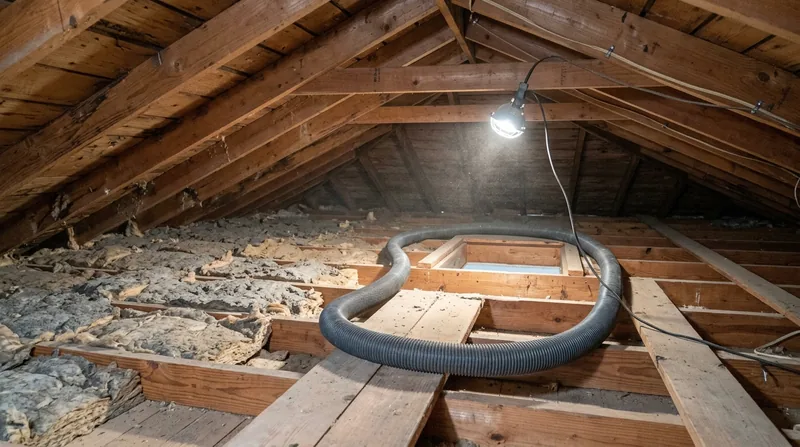




Fayetteville sits in the North Carolina Sandhills where most homes rest on vented crawl spaces raised over sandy soil or on slabs, with air handlers and ductwork baking in vented attics that hit 130 to 150 degrees Fahrenheit through long humid summers. The city's housing stock spans 1910s bungalows on brick piers in Haymount, small frame mill houses with empty wall cavities in Massey Hill, 1950s brick ranches with flattened original attic fill, and newer two-stories with finished rooms over garages that never cool without proper insulation. When old blown-in batts, wet fiberglass, failed spray foam, or squirrel-nested insulation sits above your head, insulation removal in Fayetteville is not optional, it is the foundation of every retrofit that works. We take out the old fiberglass, cellulose and failed foam, and prepare the substrate so new foam goes in clean. That discipline separates a job that lasts from one that fails again in five years.
Why Insulation Removal Matters in Fayetteville's Humid Climate
Fayetteville's subtropical humidity and the moisture-driven failures in vented attics and crawl spaces mean that old insulation traps water, compresses, and loses R-value long before it should. Blown-in fiberglass that absorbed water during Hurricane Florence or Matthew in 2016 and 2018 becomes a thermal and moisture liability. Spray foam installed without proper ventilation or over wet substrates fails, shrinks, and leaves gaps that leak air and moisture right back in. Removing the failed material completely before new foam goes down is not a cosmetic step, it is the only way to stop the cycle.
- Old blown-in and batts compress under their own weight and lose R-value by 20 to 30 percent over time in humid climates.
- Flood-soaked insulation holds moisture indefinitely and promotes mold growth in the framing below.
- Failed spray foam that shrinks or separates from the substrate creates thermal bridges and air leaks that new foam cannot fix.
- Squirrel nests, bird droppings, and rodent urine contaminate insulation and create health risks that vacuuming removes completely.
- Vermiculite insulation, common in homes built before 1980, may contain asbestos and must be flagged for professional testing before any work begins.
Starting fresh with a clean substrate is the only credible path to an insulation system that performs for decades in Fayetteville's climate.
Key info: Homes in Hope Mills and Spring Lake near Fort Bragg often carry 30-year-old fiberglass that has settled into a dense, moisture-logged mass. Removal and replacement with closed-cell foam stops the humidity cycle that no amount of air conditioning can fix.
For more information on the best insulation to install after removal, see our guide to closed-cell spray foam insulation, the gold standard for moisture control in the Sandhills.
How We Remove Insulation in Fayetteville: Step by Step
Insulation removal is not a demolition job, it is a controlled process that protects the framing, clears the space, and prepares for new work. We arrive with industrial vacuum equipment, containment barriers where needed, and a plan specific to your attic or crawl space. Every pass is documented, and the material is disposed of properly. If we find vermiculite, we flag it and stop; testing by a licensed professional comes next, never disturbance.
- We inspect the attic or crawl space and photograph existing conditions, noting any water stains, mold, active leaks, or pest activity.
- We set up containment and mechanical ventilation to control dust and odor during the removal process.
- We vacuum out all loose-fill insulation, batts, and debris using commercial-grade equipment and sealed collection bags.
- We remove failed spray foam by hand or saw, cutting it out in sections and bagging it for proper disposal.
- We sweep and vacuum the substrate clean, removing dust and contamination that would interfere with new foam adhesion.
- We flag any vermiculite in place and recommend testing before any new work proceeds.
- We walk the homeowner through the clean space and explain what new insulation will do and why.
This methodical approach means new insulation bonds properly and performs as designed for the life of the home.
Local example: A 1960s brick ranch in Southern Pines had 4 inches of settled fiberglass and a failed spray foam patch from a previous contractor. We removed both, cleaned the deck, and installed 5 inches of closed-cell foam over the entire attic. The homeowner reported 18 degrees cooler in the upstairs bedrooms by mid-summer and no moisture odor in the crawl space below.
Learn more about what comes after removal by exploring our attic spray foam insulation service and how we seal and insulate the spaces that matter most.
Insulation Removal Methods and What Each Does
| Method | Description | Best For |
|---|---|---|
| Vacuum removal of loose-fill | Industrial vacuum with sealed collection bags removes blown-in fiberglass, cellulose, or mineral wool without disturbing the substrate. | Attics with settled batts or loose fill that are dry and accessible. |
| Batt removal and bagging | Hand removal of blanket insulation and fiberglass batts, rolled and bagged for disposal. | Older attics with layered batts or crawl spaces where loose fill cannot be vacuumed safely. |
| Spray foam cutting and removal | Sectional removal of failed or poorly installed foam using saws and hand tools, bagged for disposal without disturbance. | Attics with cracked, separated, or shrunk spray foam from previous installations. |
| Substrate cleaning and sweeping | Final vacuum and wipe-down of the deck or framing to remove dust and debris that would prevent new foam from bonding. | Every removal job, prior to new insulation installation. |
| Vermiculite flagging and documentation | Identification and marking of vermiculite insulation in place, with recommendation for professional asbestos testing before disturbance. | Homes built before 1980 where vermiculite may be present in attics or walls. |
Each method is chosen based on the type of insulation, the condition of the substrate, and the scope of new work to follow. We never skip substrate preparation, it is the invisible foundation of a job that works.
Insulation Removal Cost in Fayetteville: What to Expect
The cost of insulation removal in Fayetteville starts at $950 for a standard attic with accessible blown-in or batts, and moves upward based on the square footage, the type and condition of material, and the complexity of cleanup. A 1,200-square-foot attic with settled fiberglass and light contamination runs in the low-to-mid range. A crawl space with wet insulation, failed foam, and squirrel damage costs more because the removal takes longer and disposal is more involved. Access matters, if the attic has a tight hatch or the crawl space is only 3 feet high, labor increases. Getting two to three estimates from different contractors is the smartest way to understand the true cost and scope for your specific home.
Our estimates are free and come with written detail on what we are removing, the square footage, and the disposal method. We respond within 24 hours at (472) 263-8386. For a detailed pricing breakdown and to schedule your free estimate, visit our full pricing guide.
Factors that move the cost up include the presence of water damage or mold (which requires extra care and containment), failed spray foam that must be cut out section by section, active pest nests that need removal, and attics over 2,000 square feet. If we discover vermiculite, we flag it and pause, testing by a licensed professional comes next, and that is a separate service we refer to specialists.
Insulation Removal Near Me: What Fayetteville Homeowners Should Know When Hiring
When you are looking for a spray foam contractor to handle insulation removal in Fayetteville, Spring Lake, Hope Mills, or Lumberton, the key is to verify their approach and their track record on the specific type of removal your home needs. A written estimate that names the R-value and thickness of new insulation is a sign of a contractor who knows the work. Estimates that skip these details are red flags. Check references from recent jobs in your area, ask specifically about how the contractor handled old material and whether the new insulation has stayed in place without settling or shrinking. Understand what permits apply at your address; the building official in your city has the final say on ventilation and thermal barriers, and a contractor who defers to that authority rather than guessing is the one to trust.
- Request a written estimate that specifies the type and volume of insulation being removed and the disposal method.
- Ask for references from at least two jobs completed in the past 12 months in Fayetteville or your immediate area.
- Verify that the contractor is fully insured and ask for proof of general liability and workers compensation coverage.
- Confirm that they understand local permitting requirements for your city and will coordinate with the building department if needed.
- Ask about the timeline for removal and how long the space will be open before new insulation is installed.
- Get clarity on what happens if vermiculite is found, a good contractor will flag it and refer you to a licensed testing professional.
The contractor who takes time to understand your specific situation and gives you honest guidance on what needs to come out and why is the one who will deliver a result that lasts.
Ready to get started? Contact us for a free, no-obligation estimate and let us walk you through what your home needs.
Insulation Removal in Fayetteville: Pricing Guide
| Service | Price | Details |
|---|---|---|
| Standard attic removal (blown-in or batts) | Starting at $950 | Includes vacuum removal, bagging, and substrate cleaning for accessible attics up to 1,200 square feet |
| Crawl space insulation removal | Starting at $1,200 | Removal of batts or loose fill from crawl spaces with containment and disposal, pricing varies with access and contamination |
| Failed spray foam removal | Starting at $1,400 | Sectional cutting and removal of shrunk or separated spray foam, labor-intensive work that most contractors avoid |
| Large attic or complex removal | On estimate | Attics over 2,000 square feet, water damage, active pest nests, or vermiculite require site inspection before pricing |
| Travel and service area | Included | No separate mileage or travel fee within Fayetteville and surrounding service areas including Hope Mills, Spring Lake, and Raeford |
| Free estimate | No charge | Written estimate with R-value and thickness specs for new insulation, response within 24 hours at (472) 263-8386 |
Indicative pricing, the exact cost depends on square footage, finish, and site access. Free personalized estimate within 24h at (472) 263-8386.


