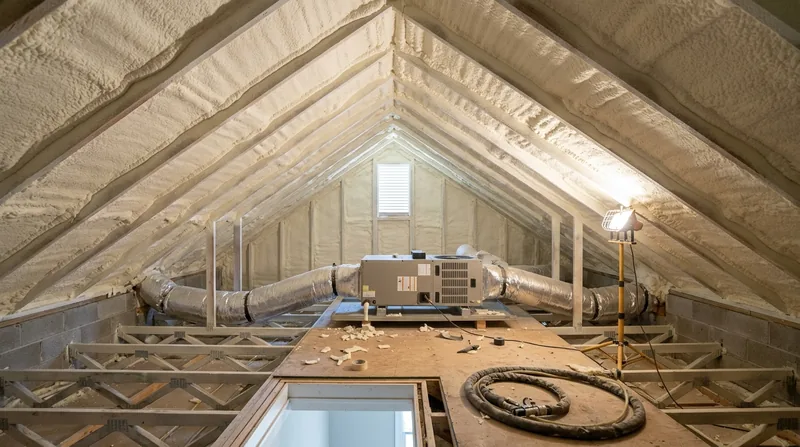




Fayetteville sits in the North Carolina Sandhills where homes rest on brick piers over sandy soil, their vented attics reaching 130 to 150 degrees Fahrenheit through long humid summers. Most of these houses, whether 1910s bungalows in Haymount, 1950s ranches in Bonnie Doone, or 1980s-2020s two-stories in Hope Mills and Spring Lake, run their air handlers and ductwork in that brutally hot attic space. Attic spray foam insulation in Fayetteville solves that problem by bringing the air handler inside the thermal envelope, turning unconditioned space into conditioned space and eliminating the brutal temperature swing that drives energy bills and uneven cooling. Open-cell foam on the roof deck, paired with proper air sealing around penetrations and rim joists, is the signature retrofit for Sandhills homes built before energy codes took hold. Every estimate lists the R-value target, the thickness per pass, and the board footage so you know exactly what you are getting.
Why Attic Spray Foam Insulation Matters in Fayetteville's Hot, Humid Climate
Fayetteville's subtropical climate and sandy-soil terrain create a perfect storm for attic failure. Vented attics pull humid outside air through soffit vents, and that moisture condenses on the cold side of fiberglass batts every time the air handler cycles. The result is rot in the roof framing, mold on insulation, and rusted ductwork that leaks conditioned air into the attic instead of into your home. A sealed attic with spray foam stops that cycle cold.
- Eliminates the 30 to 50 degree temperature difference between conditioned space and vented attic, reducing the cooling load on your system.
- Stops humid air infiltration that rots framing and degrades fiberglass over time in Fayetteville's moisture-heavy climate.
- Brings ductwork inside the thermal envelope so every ton of cooling goes into the home, not the attic.
- Creates a sealed thermal boundary that holds steady through the long humid summers and mild winters that cycle humidity in and out of uninsulated wall cavities.
A sealed attic is the single largest energy retrofit in a Sandhills home, and it is the only retrofit that stops the moisture damage that fiberglass alone cannot prevent.
Key info: Fort Bragg military families rotate through rentals in Hope Mills, Spring Lake, and Raeford every two to three years. Those FROG rooms (finished rooms over the garage) in two-story homes never cool properly with a vented attic because the garage stays hot and the attic above it acts as a thermal bypass. Spray foam on the roof deck and proper rim joist sealing fixes that problem for the next tenant.
North Carolina's building code requires an ignition barrier and thermal barrier for spray foam in attics, and the distinction matters. The local building department in Fayetteville sets the rules for your address. See Fayetteville Development Services for permit requirements and the building official's interpretation of the thermal barrier rule.
How We Spray Foam Your Attic: The Fayetteville Process
Every attic is different. A 1950s ranch in Vanstory Hills might have original fiberglass settled into a mat, while a 2000s split-level in Anderson Creek has a vented attic with modern ductwork but no insulation on the roof deck. We start with a walk-through, measure the attic space, and determine whether you need full coverage, a sealed roof deck retrofit, or a top-up of failed insulation. We then pull the estimate with the R-value target, the foam thickness per pass, and the total board footage so you see exactly what the job entails.
- Inspect the attic for moisture, existing insulation condition, and the location of air handler, ductwork, and mechanical penetrations.
- Seal large air leaks around rim joists, band joists, and the top plate of exterior walls with foam or caulk before we spray the roof deck.
- Spray open-cell or closed-cell foam on the underside of the roof deck to the target R-value, building thickness in multiple passes to ensure proper expansion and cure.
- Install the required thermal barrier (typically 1/2-inch drywall or an intumescent paint) over the foam to meet code.
- Verify the cure time (24 to 48 hours with mechanical ventilation running) before the attic is reoccupied.
The job takes one to three days depending on attic size and complexity. We handle all the air sealing around penetrations so the foam does the insulating and the sealing does the air control.
Example: A 1970s Cape Colonial in Haymount with a 1,200 sq ft attic and existing blown-in fiberglass received 4 inches of open-cell foam on the roof deck at R-19, plus air sealing around the rim joist and the penetration where the flue stack exits the roof. The job ran two days, cost was in the mid-range for Fayetteville, and the homeowner reported a 12-degree drop in the upstairs bedrooms within a week.
For more on how we handle complementary work like rim joist and band joist sealing, see our air sealing service page.
Attic Spray Foam Methods: Open Cell vs. Closed Cell
| Approach | Description | Best for |
|---|---|---|
| Open-Cell Foam | Low-density foam (0.5 lb/cu ft) that expands after application, fills cavities fully, and allows moisture vapor to pass through; R-value is 3.5 to 3.6 per inch. | Attic roof decks where you want air sealing and insulation without a vapor barrier; typical Fayetteville retrofit where humidity is managed by HVAC, not by blocking vapor. |
| Closed-Cell Foam | High-density foam (1.5 to 2.0 lb/cu ft) with a closed-cell structure that resists moisture and air; R-value is 6.0 to 6.5 per inch, requiring half the thickness of open-cell for the same R-value. | Attics with a history of moisture intrusion, or where space is tight and you need maximum R-value in minimum thickness; also the choice for metal buildings and barndominiums where condensation control is critical. |
| Hybrid: Closed-Cell Rim + Open-Cell Roof | Closed-cell foam on the rim joist and band joist (where moisture risk is highest), open-cell on the roof deck (where cost and thickness are a concern). | Fayetteville homes on brick piers where the rim joist sits above sandy soil and high humidity; balances moisture control at the foundation with cost-effective insulation on the roof deck. |
| Retrofit Over Existing Insulation | Spray 2 to 3 inches of open-cell foam over settled or failed fiberglass to restore R-value and seal air leaks without removing the old insulation. | Budget-conscious retrofits on 1950s-60s homes where removal costs are high and the existing substrate is sound; typical top-up for Vanstory Hills and Massey Hill bungalows. |
Open-cell is the standard choice for Fayetteville attics because the climate is humid year-round and the homes are cooled by HVAC, not by dehumidification. Closed-cell is the technical answer for rim joists and band joists where the soil side is always damp, and for any retrofit where you need maximum R-value in minimum space.
Attic Spray Foam Insulation Cost in Fayetteville: What to Expect
Attic spray foam insulation in Fayetteville typically starts at $1.50 per square foot for open-cell foam on the roof deck, with closed-cell running higher because of the material cost and the R-value per inch. A 1,200 sq ft attic receiving 4 inches of open-cell foam to reach R-19 would run roughly $1,800 to $2,400 before any air sealing around penetrations. That range assumes a standard roof pitch, accessible attic space, and no major obstacles like HVAC ducts or plumbing vents that need careful work.
Several factors move the price up or down. Attic access difficulty, the need to remove failed insulation first, the R-value target you choose, and whether you add rim joist sealing all affect the final number. A retrofit that requires removal of existing insulation will cost more than a top-up over sound fiberglass. Closed-cell foam costs roughly twice as much per board foot as open-cell, so a 1,200 sq ft attic with 2 inches of closed-cell would run $2,400 to $3,200.
The only way to know your actual cost is a free on-site estimate. We measure the attic, specify the R-value and thickness, calculate the board footage, and give you a price in writing. Call (472) 263-8386 for a free estimate, or visit our pricing overview for more detail on what moves the number.
Real example: A 2005 two-story colonial in Anderson Creek (Spring Lake area) with a 1,600 sq ft attic, no existing insulation on the roof deck, and a vented attic condition received 5.5 inches of open-cell foam to reach R-20 plus air sealing around the rim joist and three roof penetrations. The estimate was written with R-value, thickness per pass, and total board footage. The job cost fell in the $2,200 to $2,800 range depending on final inspection findings.
Attic Spray Foam Insulation Near Me: What Fayetteville Homeowners Should Know Before Hiring
Not all spray foam contractors are the same. The difference between a professional installation and a problem job is visible in the estimate itself. A credible contractor lists the R-value target, the foam thickness per pass, and the total board footage in writing. If an estimate gives you only a price per square foot with no R-value and no thickness, that is a red flag. Another warning sign is a price far below market with a promise to finish in one afternoon and have you back in the attic the next morning. Spray foam needs 24 to 48 hours to cure fully with mechanical ventilation running, and any contractor who promises faster re-entry is cutting corners on safety.
Verify that any contractor you hire is fully insured and can provide a certificate of insurance. Ask for references from recent jobs in Fayetteville, Hope Mills, or Spring Lake. If you are in an HOA community, check whether the architectural guidelines require approval for attic work (most do not, but some do). For homes in Haymount or downtown Fayetteville, ask the local building department whether your address falls in a historic district that requires a permit for attic work.
Get at least two estimates. The estimates should be similar in scope, R-value, and thickness if the homes are similar. A huge price difference usually means one contractor is cutting material or thickness, not offering a better deal. Call us at (472) 263-8386 or request a free estimate online so you have a baseline to compare against.
Key info: Fayetteville's building department (910-433-1400) can tell you whether your address requires a permit for attic insulation and what the thermal barrier rule means for your specific roof assembly. Ask them before you book the work. We help you navigate the permitting process, but the local building official has the final say on what your home requires.
The local independent spray foam contractor has one advantage over national franchises and one-truck operations: we are reachable, we stand behind our work, and we know Fayetteville's climate and building stock. We have been in business since 2012, and we carry full insurance. Contact us today for a free estimate with R-value and thickness specs in writing.
Attic Spray Foam Insulation in Fayetteville: Pricing Guide
| Service | Price | Details |
|---|---|---|
| Open-Cell Foam, Roof Deck Retrofit | Starting at $1.50/sq ft | Includes 4 to 6 inches of open-cell foam to R-19 or R-21, thermal barrier installation, basic air sealing around roof penetrations |
| Closed-Cell Foam, Roof Deck or Rim Joist | Starting at $3.00/sq ft | Includes 2 to 3 inches of closed-cell foam to R-12 to R-19, higher material cost, best for moisture-prone areas or where space is tight |
| Retrofit with Insulation Removal | Add $0.50 to $1.00/sq ft | Removal of failed fiberglass or cellulose, disposal, substrate prep, then foam application; cost varies by insulation type and condition |
| Hybrid: Closed-Cell Rim Joist + Open-Cell Roof | On estimate | Closed-cell on the rim and band joist (moisture control), open-cell on roof deck (cost efficiency); total depends on attic size and rim joist linear feet |
| Travel and Estimate | Free | Free on-site estimate within Fayetteville and surrounding service areas, written with R-value, thickness, and board footage; response within 24 hours |
Indicative pricing, the exact cost depends on square footage, finish, and site access. Free personalized estimate within 24h at (472) 263-8386.


