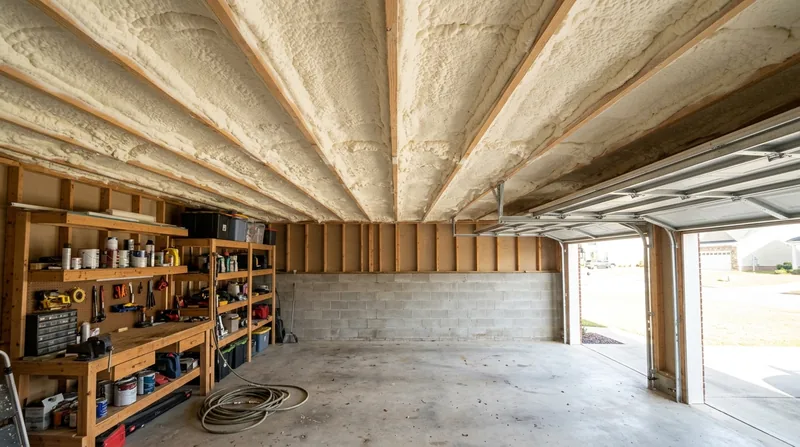




Fayetteville's military-driven housing stock includes thousands of garage spray foam insulation projects waiting to happen. From the finished rooms over garages (FROGs) in Hope Mills and Spring Lake that never cool, to workshop conversions in Massey Hill and the Cape Fear mill villages, to storage spaces that bake at 130-150 degrees Fahrenheit through long humid summers, the problem is the same: an uninsulated or poorly insulated garage ceiling that radiates heat into the living space above and wastes conditioned air. Spray foam seals the ceiling and the shared wall between garage and house, stopping radiant heat transfer and turning a storage oven into usable, comfortable space. This is not a luxury upgrade in the North Carolina Sandhills climate. It is the difference between a room that works and a room that costs you money every month.
Why Garage Spray Foam Insulation Matters in Fayetteville's Hot, Humid Climate
A garage ceiling is a thermal bridge. In summer, the attic or unconditioned space above it reaches 130-150 degrees, and that heat radiates downward through drywall and fiberglass batts (if any exist) into the room below. If that room is a bonus space, a workshop, or a finished FROG over a two-car garage, the air conditioning system works overtime to cool a space that is being heated from above. Spray foam on the ceiling stops that radiant transfer and seals air leaks around the rim joists, door frames, and penetrations that fiberglass cannot reach. The humidity that drives mold and moisture problems in Fayetteville crawl spaces also finds its way into poorly sealed garage cavities, especially in rental properties that turn over with every military move and whose HVAC systems have never been properly balanced.
- Spray foam adheres to rafters, rim joists, and rim band areas where air leaks originate, sealing them in a single application.
- Open-cell foam allows drying to the interior if moisture enters, and costs less than closed-cell for attic-side garage ceiling work.
- Closed-cell foam provides higher R-value per inch and vapor resistance if the garage wall or ceiling is exposed to weather or high humidity.
- A properly insulated and sealed garage ceiling reduces the cooling load on the HVAC system and makes the bonus room or workshop usable year-round.
The result is immediate and measurable: the room becomes comfortable, the system runs less often, and the homeowner stops paying to heat and cool an uninsulated cavity.
Key info: Fort Bragg and the military housing corridor from Hope Mills to Spring Lake generate steady demand for garage insulation because rental turnovers require upgrades to meet tenant comfort standards and reduce HVAC strain. A finished room over a two-car garage in Cliffdale or Anderson Creek can be 15-25 degrees warmer than the main house without sealed insulation on the ceiling.
For more on sealing air leaks throughout the home, see our air sealing service page.
How We Insulate and Seal Your Garage Ceiling in Fayetteville
The process starts with a site visit and a clear estimate that specifies the R-value, foam thickness in inches, and the square footage of ceiling and wall cavities to be sprayed. We identify all air leaks, penetrations, and thermal bridges, then choose the foam type based on your space and moisture profile. For a typical garage ceiling under a living space, we spray directly onto the underside of the roof deck or attic floor, adhering the foam and creating a continuous thermal barrier. The application is precise, controlled, and followed by proper mechanical ventilation during cure. Re-entry is safe after 24 to 48 hours, depending on conditions and foam type.
- We perform a detailed walkthrough and identify all framing, electrical, and mechanical obstacles before spraying begins.
- Foam is applied in controlled passes to achieve the specified thickness and density without over-application or waste.
- Mechanical ventilation runs during and after application to manage off-gassing and ensure rapid, safe cure.
- We trim excess foam flush with framing and leave the ceiling ready for drywall, paint, or finish installation.
- The estimate includes R-value, thickness, and square footage so you know exactly what you are paying for and why.
The entire process takes one to two days depending on ceiling size and complexity. You receive a written warranty on the installation and a clear re-entry timeline before work begins.
Local example: A 400-square-foot FROG ceiling in a Vanstory Hills ranch home typically receives 5.5 to 6.5 inches of open-cell foam (R-19 to R-23) or 3 to 3.5 inches of closed-cell foam (R-18 to R-21), depending on whether the space is climate-controlled and whether moisture control is a priority. The sealed rim joist where the garage wall meets the attic is sprayed as part of the same job, eliminating the air leak that fiberglass alone cannot seal.
For comprehensive air sealing beyond the garage ceiling, explore our attic spray foam insulation service to seal and insulate the entire conditioned boundary.
Garage Spray Foam Insulation Methods: Foam Type and Application
| Approach | Description | Best for |
|---|---|---|
| Open-Cell Spray Foam | Lower density, higher thickness per R-value, allows interior drying, lower cost per square foot. | Garage ceilings in climate-controlled bonus rooms where moisture is managed by HVAC and dehumidification. |
| Closed-Cell Spray Foam | Higher density, higher R-value per inch, vapor barrier properties, excellent moisture resistance. | Garage walls exposed to weather, ceilings in unconditioned or semi-conditioned spaces, high-humidity environments. |
| Rim Joist and Band Joist Sealing | Spray foam applied to the perimeter where garage wall meets attic or rim joist, sealing air infiltration. | All garage insulation jobs, as rim leaks are the primary source of unconditioned air entry and thermal loss. |
| Ceiling and Shared Wall Combination | Foam applied to both garage ceiling (under living space) and the shared interior wall between garage and house. | Converting a garage to a finished room or workshop where both thermal and sound isolation improve comfort and usability. |
Garage Spray Foam Insulation Cost in Fayetteville: What to Expect
A typical garage ceiling insulation project in Fayetteville starts at $1,200 for a small single-car space or partial coverage, and scales upward based on square footage, foam type, thickness, and access complexity. A 400-square-foot FROG ceiling (two-car garage footprint) with open-cell foam typically runs $2,000 to $3,200, while closed-cell applications cost more due to higher material and application time. The final price depends on several concrete factors: the existing insulation or substrate condition (we may need to remove failed foam or wet fiberglass first), whether the rim joist and band areas are included, ceiling height and framing access, and whether mechanical ventilation must be installed or extended to serve the space during cure.
Getting a written estimate with R-value, thickness, and square footage is the only way to compare fairly. Avoid any quote that omits these specifications or promises a price without an on-site inspection. We provide free estimates within 24 hours at (472) 263-8386, and our estimates are detailed enough to be binding. For a complete pricing overview and to understand the factors that move costs up or down, visit our full pricing page.
If your garage has old, wet, or contaminated insulation, insulation removal must happen first, which adds to the timeline and cost but is essential for a sound installation.
Garage Spray Foam Insulation Near Me: What Fayetteville Homeowners Should Know When Hiring
Hiring a spray foam contractor is not a commodity decision. The difference between a professional installation and a rushed job is visible only after the foam cures and the space is sealed. A reputable contractor will provide a written estimate with R-value and thickness, explain the foam type and why it suits your space, outline the cure timeline and re-entry window, and carry full insurance that can be verified. Avoid any contractor who promises immediate re-entry, cannot specify foam thickness or R-value, or quotes a price without an on-site visit. Check references from recent local jobs, not just testimonials on their website. If your home is in an HOA community (common in Bonnie Doone, Vanstory Hills, or golf communities like Southern Pines and Pinehurst), confirm that exterior work does not require architectural approval before starting.
- Request a written estimate that names the foam type, R-value per inch, thickness in inches, and total square footage to be sprayed.
- Verify that the contractor carries full insurance and ask for a certificate of insurance before work begins.
- Ask about the cure timeline, re-entry window, and mechanical ventilation setup during application.
- Check at least two references from homeowners in Fayetteville, Hope Mills, or Spring Lake who had garage insulation done in the past 12 months.
- Confirm that the estimate is free and no-obligation, and that the contractor responds to questions and concerns during and after the job.
When you are ready to move forward, contact us for a free estimate. We have served Fayetteville and the surrounding area since 2012, and we are fully insured and available for jobs year-round.
Garage Spray Foam Insulation in Fayetteville: Pricing Guide
| Service | Price | Details |
|---|---|---|
| Single-car garage ceiling (150-200 sq ft) | Starting at $1,200 | Open-cell foam, basic rim and ceiling sealing, assumes clean substrate and standard access |
| Two-car garage or FROG ceiling (300-500 sq ft) | Starting at $2,000 | Open-cell or closed-cell foam, ceiling and shared wall coverage, rim joist sealing included |
| Closed-cell application or high-humidity spaces | Starting at $2,500 | Higher R-value per inch, vapor barrier properties, suitable for weather-exposed or moisture-prone areas |
| Insulation removal before spray (if needed) | On estimate | Wet, failed, or contaminated insulation must be removed first, cost depends on volume and disposal |
| Free estimate | No charge | On-site visit, written quote with R-value and thickness, response within 24 hours at (472) 263-8386 |
Indicative pricing, the exact cost depends on square footage, finish, and site access. Free personalized estimate within 24h at (472) 263-8386.


